Adult traffic by GEO
Choosing Countries When You Buy Adult Traffic
Buy Tier 3 countries first to find sources that work, then re-test the winners in Tier 1 markets such as the US, the UK and Germany, where offers pay enough to carry higher bids. Tier 2 often becomes the steady earner once a funnel is stable. Treat every country as a separate test with its own budget, bid and verdict, because the same offer can profit in one GEO and lose money next door.
How Adult Traffic GEOs Are Grouped
Three tiers cover most buying decisions, and the grouping is a convention, not a standard. Check your offer's GEO list before trusting this table.
| Tier | Example markets (common convention) | Role in a campaign |
|---|---|---|
| Tier 1 | US, UK, Canada, Australia, Germany, Nordics | Scale proven sources, premium offers |
| Tier 2 | Spain, Italy, Poland, Czech Republic, Brazil, Mexico | Localized funnels, steady margin |
| Tier 3 | India, Indonesia, Philippines, Vietnam, Egypt | Cheap source discovery, funnel debugging |
Payout defines a tier in practice, not traffic price. A cheap country with no matching offer is not a market. It is just a cost.
Discover Sources Cheap, Re-Test in Tier 1
Cheap GEOs answer one question well: which sources send real people at all. A low CPC buys enough clicks per source ID to separate dead placements from live ones. The arithmetic is simple: $100 at $0.002 per click buys 50,000 clicks, while $100 at $0.02 buys 5,000.
Skip Tier 1 for brand-new funnels. Paying US prices to discover a broken pre-lander button is money thrown away.
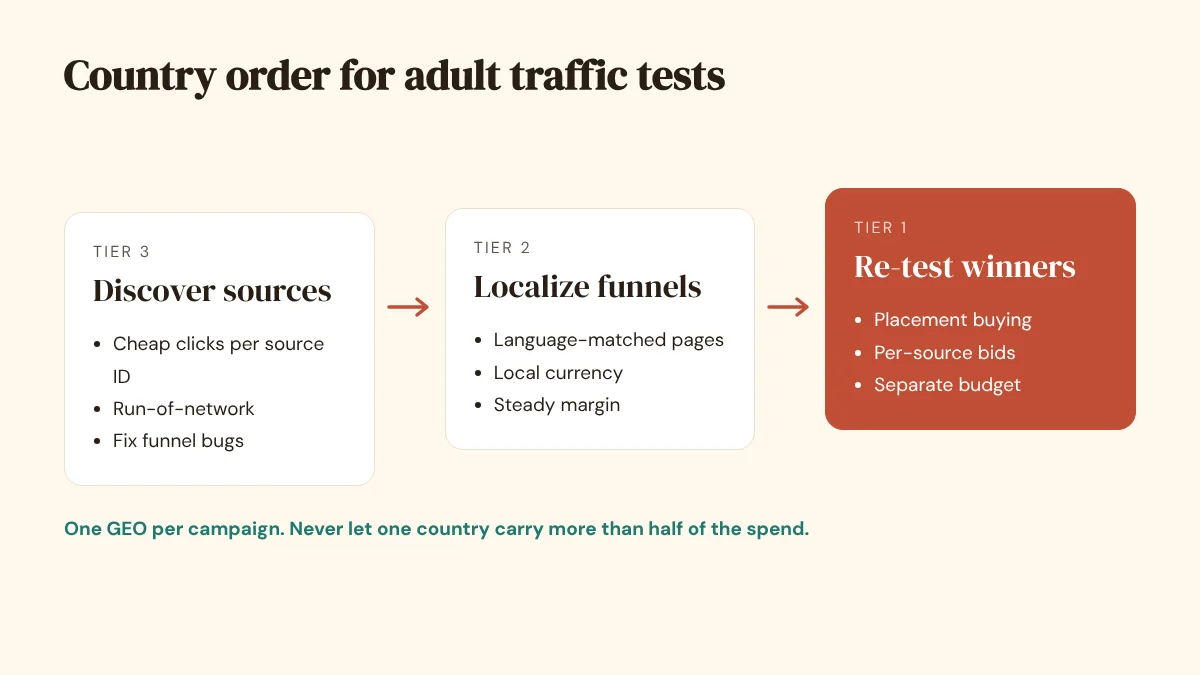
Re-test, never copy, when a source moves up. A site that converts in Indonesia proves its users are real, but it says nothing about its US volume or whether the US auction leaves you any margin. Four steps keep the move disciplined:
- Run run-of-network in one Tier 3 country per campaign and log conversions per source ID.
- Blacklist dead sources and keep the ones that convert or show real landing page activity.
- Launch the Tier 1 campaign as placement buying, limited to the survivors.
- Use source ID bidding so each site gets its own price instead of one flat bid.
Offer restrictions override this order. If the offer only accepts US or UK traffic, cheap GEOs teach you nothing about it, so start in Tier 1 with a tight whitelist and a small daily cap.
Latin America as a Testing Ground
Latin America lets one funnel, translated twice, cover a whole region. Portuguese covers Brazil and Spanish covers most of the rest, from Mexico to Argentina, so two landing page versions open many separate auctions.
Portuguese pages go to Brazil, no exceptions. A Spanish page shown to a Brazilian user tells them nobody bothered to localize, and the click is wasted. Translate the pre-lander, the buttons and the offer page, not just the headline.
Browser language targeting fixes mismatches inside a country. Pair Brazil with Portuguese browser language, and each Spanish-speaking country with Spanish. English-language browsers in those countries get their own campaign with an English page, or get excluded.
Local prices earn more trust than perfect grammar. Show the local currency and list only the payment methods the offer accepts in that country. A dollar price on a Mexican page reads like a foreign site, even with a flawless translation.
Age-Verification Laws and Disappearing Inventory
Age-verification laws can switch a GEO off on the date they take effect. Publishers may add a verification wall or geo-block the country entirely, and the inventory you were buying leaves with them.
Watch effective dates, not headlines. Cut the GEO's daily budget before the start date, because traffic that survives the cutoff comes from a different mix of sites than the one you tested.
Recovery is often partial. Inventory may return on one operating system before the others, so restart with a separate campaign per OS rather than a blended one that averages a recovered OS with a dead one.
Concentration is the real risk. Never let one GEO carry more than half of an offer's total spend across your campaigns. If one country brings most of your revenue, one law can wipe out most of it in a single day. Check local advertising rules with a lawyer in your jurisdiction too, because legal adult advertising is not regulated the same way everywhere.
VPN Users and Misleading GEO Reports
VPN users distort GEO reports quietly. VPN use rises where age checks arrive, so a click labeled Netherlands may come from someone in a country your offer rejects. The lead fails, no postback fires, and the GEO looks dead when the real problem is location.
Exclude proxies and IPv6 at the targeting level. On AdsCompass both filters apply before the impression is bought, so you never pay for a click you would later throw away in the tracker.
Browser language is the cheapest cross-check. A Brazil campaign full of browsers set to languages with no local audience is showing you VPN exits, not Brazilians.
ISP and carrier targeting closes the gap. VPN exits sit on hosting networks, not on local mobile carriers. If a country converts on carrier traffic but fails on broadband, check connection type and the broadband ISPs before you blame the GEO.
Setting Up GEO Targeting on AdsCompass
AdsCompass covers 200+ GEOs, so availability is rarely the limit. Budget and offer acceptance are. A $50 deposit is enough to buy adult traffic on AdsCompass in any of those countries. Registration at adscompass.com is free.
- Size the GEO first. Open the Traffic Calculator, available after free registration with no deposit, and check volume and average CPC by country and format with the mobile, desktop or combined filter.
- Run one GEO per campaign. Price comes from the auction, not a per-GEO rate card, so a mixed campaign lets the cheapest country eat the budget.
- Daypart in local time. Select the target country's timezone in dayparting, or an evening schedule for Mexico runs on your own clock.
- Filter before you buy. Turn on proxy and IPv6 exclusion, then add browser language and carrier rules where the GEO needs them.
Calculator averages are a reference, not a price, and a minimum bid is accepted but not competitive. Set daily and hourly budgets per GEO and use even 24-hour spend for new countries, so one busy hour does not burn the whole day.
GEO Questions From Adult Traffic Buyers
Should I test Tier 1 or Tier 3 first?
Tier 3 first, unless the offer only accepts Tier 1 countries. Cheap clicks let you find live source IDs and fix funnel bugs before you pay Tier 1 prices. Then move the proven sources up and re-test them with a separate budget.
Should one campaign target several countries?
No, run one country per campaign. Mixed campaigns let the cheapest GEO absorb the budget and hide which country actually paid. A shared language changes nothing here: Mexico and Colombia both read Spanish, but they still need separate bids and reports.
What should I do when a country's traffic suddenly drops?
Check legal changes first, then your own settings. A new age-verification rule, a source that left your whitelist and a bid that fell below the current auction price all look the same on a volume chart. Compare OS and source ID splits with last week, then check the Traffic Calculator to see whether the market shrank or only your share.